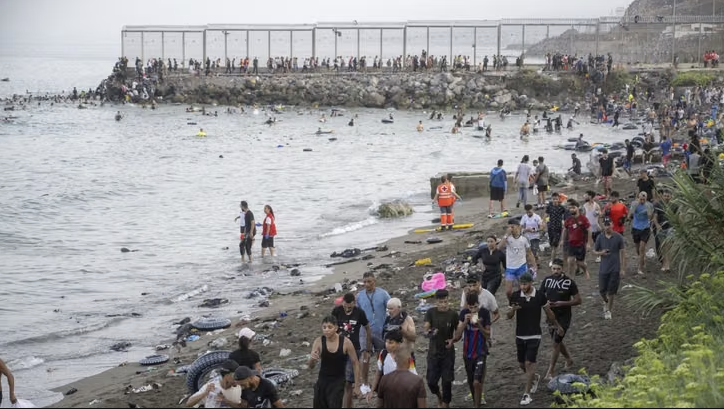
Morocco–Spain immigration is reaching an intensity in August 2026 not seen since the Canary Islands crisis of 2024–2025: more than 28,400 irregular arrivals recorded on Spanish coasts since January (+18% year-on-year), with nearly 62% via the Atlantic route along Western Sahara and Morocco, and the rest through the western Mediterranean and the enclaves of Ceuta and Melilla. Madrid and Rabat are holding emergency meetings while NGOs denounce saturated reception conditions and contested forced returns. WOP360 breaks down the figures, bilateral agreements, the European Union response and humanitarian stakes — with links to our Morocco desk, Spain desk and Politics section.
The Morocco–Spain partnership has become, over the past decade, the pivot of European migration policy in the western Mediterranean. Rabat treats flow management as a diplomatic lever (recognition of the Sahara autonomy plan, EU funds, security cooperation); Madrid seeks to avoid a repeat of the 2021 images — mass attempts to enter Ceuta and Melilla — while facing growing domestic pressure from the far right and some autonomous regions. Summer 2026 crystallises these tensions with repeated shipwrecks off the Canaries and queues of asylum seekers in the islands and Andalusia.
Key figures: a tense 2026
According to Spain's Interior Ministry and data consolidated by the Migration Observatory (Comillas University), Spain recorded 28,412 maritime arrivals between 1 January and 3 August 2026. The Canary Islands route accounts for 17,650 people — mostly nationals of Mali, Senegal, Guinea and Burkina Faso who transited through informal camps in southern Morocco or Mauritania. The western Mediterranean (Strait of Gibraltar, Andalusian coast) logged 6,890 arrivals, often in smaller but more frequent boats in summer.
The enclaves of Ceuta (≈ 4,120 attempts or entries recorded) and Melilla (≈ 2,340) remain symbolically sensitive: reinforced barriers, negotiations with Rabat on pushbacks and returns of unaccompanied minors. The death toll at sea is estimated by NGO Caminando Fronteras at 1,247 people missing or drowned on all routes to Spain since January — a figure disputed by Madrid but reported by several Iberian media (El País, La Vanguardia).
- Canaries: ~17,650 arrivals · Atlantic route · saturated reception centres in Tenerife and Gran Canaria
- Western Mediterranean: ~6,890 arrivals · Strait of Gibraltar · Guardia Civil / Salvamento Marítimo rescue operations
- Ceuta: ~4,120 incidents · double fence · tensions with Morocco over returns
- Melilla: ~2,340 incidents · reinforced police cooperation · debate on minors
- Deaths at sea (NGO): ~1,247 since January 2026 · Canaries and Alboran routes
Ceuta and Melilla: two European enclaves at the heart of the debate
The autonomous cities of Ceuta and Melilla, the EU's only land territories in North Africa, concentrate some of the most striking images of Morocco Spain immigration. Barriers — double fences, razor wire, thermal cameras — were reinforced after the events of May 2021, when several thousand people crossed the Moroccan border at Ceuta in hours. In 2026, Spanish authorities deploy extra Guardia Civil and national police units while Rabat maintains patrols on the Moroccan side.
The dispute is less about absolute numbers — relatively low compared with the Canaries — than about the status of minors and return procedures. Madrid sometimes accuses Rabat of temporarily easing controls to exert diplomatic pressure; Morocco denies this and highlights efforts against people-smuggling networks. Rights groups (Amnesty International, CEAR, Andalucía Acoge) document cases of border pushbacks without individual asylum assessment — illegal under EU law, according to prior CJEU rulings.
For residents of Ceuta and Melilla, the stakes are also economic and social: strained public services, debate over reception versus transfer to the mainland, and the rise of the far right (Vox) in local discourse. WOP360 covers these dynamics on the Spain desk and Politics analyses on the Maghreb.
Atlantic route: why the Canaries remain the priority
The Canary Islands route — boats leaving southern Morocco, Mauritania or Western Sahara — has become the main axis of irregular immigration to Spain since the late 2010s. Distance (800 to 1,500 km depending on departure point), fragile craft (« cayucos », overloaded pirogues) and Atlantic currents explain a particularly high mortality rate. In August 2026, reception centres in the islands report occupancy above 140% according to the Canary Islands government delegation.
The profile of arrivals has shifted: fewer Moroccans (now a minority on this route), more West African and Sahel nationals fleeing instability, drought or extremism. Morocco plays a transit and filtering role: Moroccan authorities regularly announce dismantling of camps and arrests of smugglers, with EU financial and material support via the EU Emergency Trust Fund for Africa.
Sea rescues mobilise Salvamento Marítimo, the Spanish navy, sometimes merchant ships and increasingly Frontex. Registration and asylum processing delays in Las Palmas and Santa Cruz fuel a humanitarian « backlog » denounced by UNHCR and local associations.
Morocco–Spain agreements and readmission: the bilateral framework
Since the 2022 diplomatic normalisation — after the Spanish presidency crisis over the Sahara — Madrid and Rabat signed several protocols strengthening migration cooperation. A framework agreement provides for accelerated returns of Moroccan nationals in irregular status in Spain, in exchange for easier visas for Moroccan seasonal workers and investment in training and youth employment in Morocco.
In 2026, the Spanish government claims more than 12,800 returns to Morocco since January (Interior Ministry figures), including people apprehended at Ceuta and Melilla borders. NGOs contest the transparency of these statistics and the distinction between « voluntary return » and « pushback ». Rabat, meanwhile, demands that Spain and the EU recognise the « essential » nature of Moroccan cooperation — a recurring argument at EU–Morocco summits.
- Work visas: agricultural and hotel quotas for Moroccan nationals — tool for legal flow regulation
- Readmission: fast-track procedures for Moroccans in irregular status · timelines contested by lawyers
- EU funding: migration envelopes linked to neighbourhood partnership · control of Morocco's southern borders
- Sahara dimension: migration cooperation remains tied, in official discourse, to the overall strategic partnership
European Union, Frontex and the southern neighbourhood
Brussels treats Morocco as a privileged southern neighbourhood partner: funds for border management, equipment, auxiliary force training and development programmes aimed at « retaining » populations south of the Sahara. Frontex has reinforced its presence in the western Mediterranean and coordinates returns to third countries within a legal framework debated in the European Parliament.
In August 2026, the European Commission is preparing a new « migration externalisation » package including Morocco-type agreements with Tunisia and Mauritania. Left-wing MEPs and NGOs (Statewatch, EU Observer) warn of outsourcing asylum-law violations. EPP and social-democrat governments, including Spain, defend a « comprehensive » approach mixing border control and legal migration pathways.
For Morocco, the stakes are twofold: preserve EU funding flows and avoid being seen as Europe's « gendarme » by Moroccan public opinion, sensitive to images of sub-Saharan migrants blocked at Melilla gates or in informal camps in the north of the country.
Humanitarian dimension: reception, saturation and rights
Humanitarian associations describe a structural reception crisis in Spain: lack of emergency centre places, slow asylum commissions, unaccompanied minors housed in precarious conditions in Ceuta and the Canaries. CEAR and the Red Cross call for a summer emergency plan and faster transfer to the mainland to relieve the islands.
In Morocco, local and international NGOs document expulsions of people in irregular status towards the south of the country or the Algerian border — practices hard to verify independently but regularly cited in Human Rights Watch reports. The Moroccan government highlights humanitarian operations (water, food, medical care) during arrests of transit groups.
Media debate often pits « border security » against « human dignity ». WOP360 reminds readers that international law requires individual examination of protection claims and prohibits collective pushbacks — principles reaffirmed by the European Court of Human Rights in cases involving Spain and Morocco.
Political stakes in Madrid and Rabat
In Spain, the coalition government faces opposition accusing the executive of migration « laxity », while regions governed by the People's Party and Vox demand more controls and fewer transfers from the Canaries. The Interior Minister announced in July 2026 a reinforcement of 900 agents on maritime routes and extra budget for « orderly » returns.
In Morocco, King Mohammed VI and the Akhannouch government present the kingdom as a « responsible » actor for regional stability while negotiating with Paris and Madrid on the Sahara and investments. Moroccan press (Le Matin, Medias24, MAP) emphasises arrests of criminal networks and seized sums; Spanish press focuses more on arrivals and shipwrecks.
Local elections and rising nationalism in Europe fuel instrumentalisation of the migration file. For migrants themselves — whether Moroccan economic migrants or sub-Saharan transit passengers — the reality remains deadly crossings, debts to smugglers and legal uncertainty for months or years.
Regional comparisons: Algeria, Italy and the central Mediterranean
Morocco Spain immigration does not operate in isolation. Algeria also sees departures towards Spanish coasts (Almería route), with dynamics distinct from Rabat–Madrid cooperation. Italy and Greece remain the EU's main entry points by overall volume, but the Atlantic route to the Canaries concentrates summer 2026 media attention due to rising deaths.
IOM analysts note that any reduction in arrivals on one route often shifts flows elsewhere — observed after Morocco's 2019–2020 tightening, which temporarily displaced traffic towards Mauritania. WOP360 tracks these shifts on the Morocco desk, MENA and Europe regions.
Outlook: what to expect for late summer 2026
As long as « push » factors (Sahel conflicts, climate change, demographics) remain and legal migration pathways stay limited, experts expect arrivals to Spain to continue until autumn, with a traditional peak in August–September on the western Mediterranean. Madrid and Rabat are likely to announce, after the summer break, a migration summit and additional work-visa quotas.
The underlying question — sharing responsibility within the EU (solidarity mechanism, relocations) — remains unresolved. Without reform, border regions and the Canary Islands will continue to bear a disproportionate burden, while Morocco stays at the centre of negotiations as an indispensable and critical partner.
Expert analysis (E-E-A-T)
« Morocco–Spain immigration is no longer just a security file: it is a credibility test for the EU, a geopolitical lever for Rabat and a humanitarian emergency in the Canaries. As long as Europe externalises without opening enough legal pathways, summer crisis cycles will repeat. » — Karim Benali, WOP360 Maghreb politics editor
Frequently asked questions (FAQ)
How many migrants have arrived in Spain from Morocco in 2026?
About 28,412 maritime arrivals recorded between January and early August 2026; most via the Canaries, with frequent transit through southern Morocco or Mauritania. Ceuta and Melilla represent a smaller but symbolically important share.
What is Morocco's role in immigration to Spain?
EU partner for border control, transit country for sub-Saharan nationals, and source of Moroccan economic migration. Rabat negotiates readmission deals, work visas and European funding.
Why do the Canaries concentrate arrivals?
The Atlantic route bypasses tightening in the Strait of Gibraltar; smugglers use boats leaving Western Sahara, Mauritania or southern Morocco, with long and deadly crossings.
What is happening in Ceuta and Melilla?
Two Spanish enclaves in North Africa with reinforced barriers. Entry attempts, debates on unaccompanied minors and returns to Morocco. Recurrent bilateral tensions over procedures.
Does Spain return migrants to Morocco?
Yes: Madrid claims more than 12,800 returns to Morocco since January 2026 under bilateral agreements. NGOs contest some fast-track border procedures.
What is the human toll at sea?
NGO Caminando Fronteras estimates about 1,247 dead or missing on routes to Spain since January 2026; Spanish authorities publish rescue figures without always consolidating deaths at sea.
Where to follow Morocco–Spain immigration news on WOP360?
Morocco desk (/morocco), Spain (/spain), Politics (/category/politics), MENA and Europe regions. This article is updated when bilateral official announcements are made.
Conclusion and next steps
The Morocco–Spain migration crisis of summer 2026 illustrates the limits of a policy built on border control without sufficient legal pathways: record Canary Islands arrivals, tensions in Ceuta and Melilla, debate over readmission agreements and human suffering at sea. Madrid and Rabat remain linked by geography and mutual interest; the EU seeks a fragile balance between externalisation and solidarity.
WOP360 — Morocco desk · Spain · Politics · MENA · Europe.

