Two explosions rang out on Tuesday 7 July 2026 in central Damascus, close to the Four Seasons Hotel where French President Emmanuel Macron had spent the night — minutes after his motorcade left for the presidential palace. Macron, on a historic visit to Syria, was unhurt: he was already in a meeting with Syrian President Ahmed al-Sharaa when the blasts occurred, the Élysée confirmed. WOP360 sets out the established facts, the human toll, the diplomatic context and the security stakes — with links to our France desk and the Politics section.
The event casts a shadow over the first visit by a head of state from the European Union to Damascus since the fall of Bashar al-Assad's regime in December 2024. Macron had been a driving force behind easing Western sanctions; al-Sharaa, a former rebel leader turned head of state, sought to present "the new Syria" to a major European partner. Syrian authorities describe devices placed in a car and a rubbish bin, detonated during an attempted neutralisation.
Timeline: what happened Tuesday morning
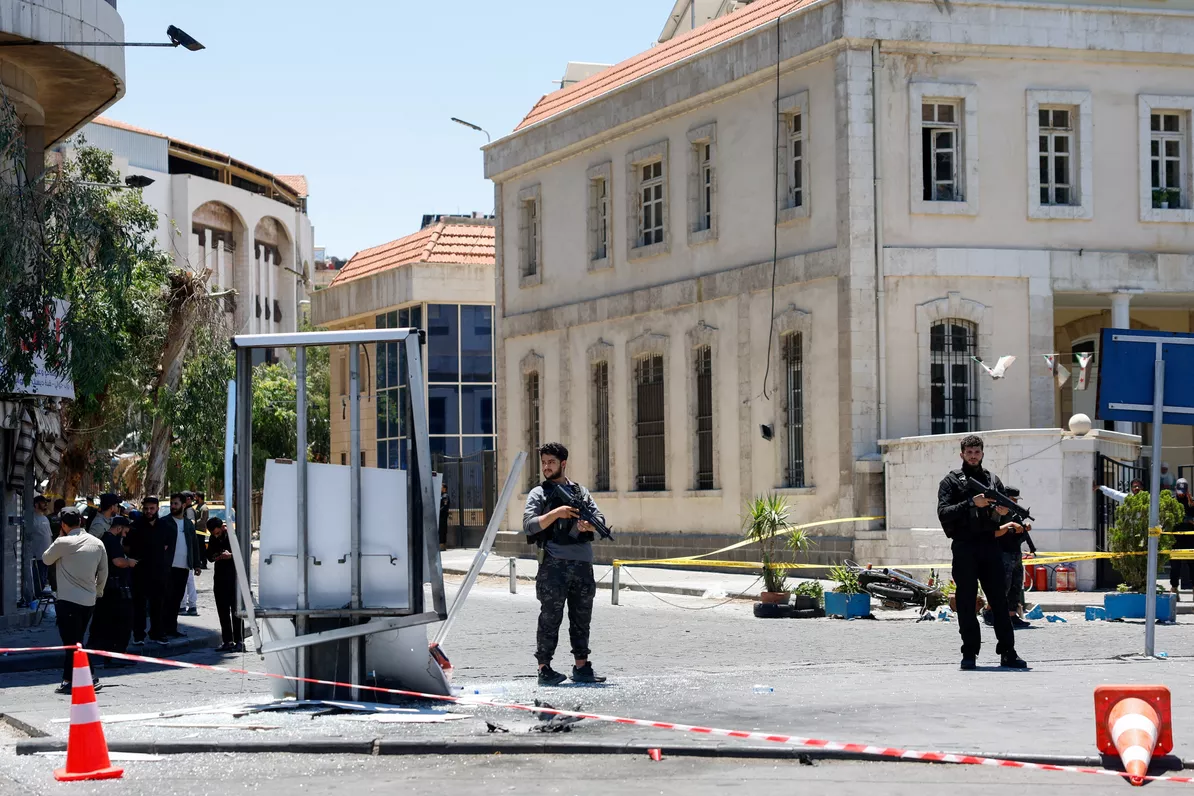
According to French media (BFMTV, France Info) and international agencies (Reuters, AFP, AP), the sequence unfolded as follows: Macron left the Four Seasons for the presidential palace for an official meeting with al-Sharaa and their respective delegations. Shortly after the presidential convoy passed, a first blast erupted in a rubbish bin; a second followed metres away, near a parked ambulance in the area.
Images verified by Reuters and shared on social networks show flames and smoke on a busy central artery, near the Tourism Ministry and the Damascus National Museum. Syria's Interior Ministry says the devices exploded "while preparations were under way" to defuse them — wording echoed by the official SANA agency.
- Location: central Damascus, Four Seasons / Tourism sector
- Timing: Tuesday 7 July 2026, morning (local time)
- Presumed target: Macron visit route or symbolism (no claim of responsibility)
- Macron's status: safe at the presidential palace; visit continuing
The Four Seasons, the usual base for foreign visitors
The Four Seasons Hotel Damascus is one of the few upscale establishments regularly hosting diplomats, NGOs and foreign journalists since the partial reopening of the Syrian capital. Macron stayed there the night before the palace meeting — a standard logistical choice for Western delegations, but one that concentrates media attention on security risk.
French security services had established a perimeter around the hotel and the route to the palace. Syria's Interior Ministry states that the explosions occurred outside the reserved perimeter for the residence and presidential route — an important nuance at this stage to rule out a direct hit on the convoy. Experts cited by Al Jazeera do not exclude an attempt targeting the French delegation or aimed at destabilising the image of a "normalised Syria" promoted by al-Sharaa.
Human toll: from 18 injured to 36, one death confirmed
Figures shifted in the hours after the attack — a familiar pattern in early casualty reporting. SANA and the Syrian ministry initially announced 18 injured, including four police officers, with no immediate confirmed death. The next day, Syria's Health Ministry raised the toll to one dead and 36 injured, specifying that 31 people had "minor injuries" and five were hospitalised in a "stable condition".
Witnesses cited by AP and CBS News describe a crowded street at the time of the blasts, with roughly twenty people near the second explosion. Blood traces and a burnt-out vehicle were observed on site. No French casualties were reported; the Élysée has not commented on injuries in the president's entourage.
Five days earlier, another device had exploded in a café near the justice palace in Damascus, killing at least ten people and injuring about twenty according to the Health Ministry — context that heightens concern over the new authorities' ability to secure the capital despite months of relative calm.
Macron unharmed: Élysée reaction and visit continues
In a statement to the press, the French presidency confirmed that Macron had not heard the explosions and that he was continuing his programme in Damascus before travelling to Ankara for the NATO summit, where al-Sharaa was also due to attend. An Élysée official, quoted anonymously by AP, said the bilateral meeting with the Syrian president was proceeding normally.
On X, Macron posted a message on Tuesday evening without explicitly mentioning the attacks, but praising "the aspiration of Syrian women and men to live in a fully sovereign, safe, pluralist and united Syria" and concluding: "My visit continues." In Paris, that wording was read as a refusal to yield to security intimidation.
CBS News and several US outlets described the incident as a "possible assassination attempt"; the Élysée and Syrian authorities favoured measured communication, stressing the absence of a direct threat to the president once at the palace. The distinction matters legally and diplomatically: terrorist claim or local criminal act still unclear.
Historic visit: Macron, first EU head of state in Damascus since 2024
Emmanuel Macron is the first leader from the European Union to visit Syria since the fall of Bashar al-Assad in December 2024. Before him, only the Emir of Qatar and Ukrainian President Volodymyr Zelensky had paid a state visit to Damascus in this political sequence.
France, alongside European and American partners, pushed to ease part of the sanctions imposed under Assad — arguing for support for reconstruction and to avoid humanitarian collapse. Macron and al-Sharaa discussed Syrian sovereignty, security stabilisation, reconciliation and economic reopening. The protocol handshake at the palace, broadcast by Syrian state media, contrasted sharply with images of smoke near the Four Seasons minutes earlier.
For al-Sharaa, a former jihadist figure reimagined as head of state, the stakes are existential: proving he controls Damascus and can host a Western leader without a major incident. The two blasts weaken that narrative — even though the visit was not interrupted.
What is known about the devices and the investigation
Syria's Interior Ministry described two devices: one placed in a parked car by the roadside, the other in a rubbish container. Security forces were apparently trying to neutralise them when the detonations occurred — a scenario that could indicate prior discovery by services or hazardous handling of already primed devices.
No group has claimed Tuesday's attack. Open lines of inquiry include: loyalist cells to the former regime, residual Islamist factions, crime linked to militias, or an internal destabilisation act targeting al-Sharaa's power by using the timing of the French visit as a media showcase. Syrian investigators, with possible French intelligence support, are working on CCTV footage and debris.
Security analysts interviewed by Al Jazeera estimate the devices may have been timed to coincide with the departure of the presidential motorcade — a hypothesis not officially confirmed. The temporal proximity to the café attack (3 July) suggests structural security fragility rather than an isolated incident.
Security context: Damascus between relative calm and sporadic violence
Since Assad's fall, Damascus had remained largely peaceful compared with the civil war years — which had encouraged progressive diplomatic visits. Transition authorities nonetheless struggle to unify the security apparatus and disarm armed factions outside state control.
- 3 July 2026: explosion in a café near the justice palace — at least 10 dead
- 7 July 2026: double blast near the Four Seasons — 1 dead, 36 injured (Health Ministry toll)
- Stakes: international credibility of the al-Sharaa regime
- Response: reinforced checkpoints in the city centre reported by correspondents on the ground
Syrians in the diaspora and humanitarian NGOs are watching closely whether authorities can protect areas frequented by foreigners — a sine qua non for tourism, investment and promised European aid conditional on stabilisation.
Correspondents on the ground report increased patrols around diplomatic hotels and government buildings in the 48 hours after the blasts. Business travellers who had resumed limited trips to Damascus are reassessing itineraries; several European chambers of commerce had planned fact-finding missions for late July that may now be postponed pending clearer security guarantees from Syrian and French services.
Diplomatic stakes for France and Europe
Paris seeks a delicate balance: re-engagement with Damascus without legitimising al-Sharaa's jihadist past, partial lifting of sanctions without abandoning demands for justice for crimes under Assad and during the war. The explosions complicate the case for rapid normalisation in Brussels and Berlin.
Macron was due to continue to the NATO summit in Ankara with a packed agenda: Ukraine, the Middle East, defence budgets. Syria featured as a peripheral but symbolic topic — proof that Europe and Turkey no longer ignore Damascus. The double attack could tighten security conditions imposed on future Western delegations.
On the Syrian side, al-Sharaa welcomed Macron with a speech on "Syria that has decided to rise again." Protocol images aim to erase HTS's military legacy; smoke in the city centre reminds us the transition remains militarily and politically contested.
European Parliament groups are split: some centrist and liberal factions argue that engagement is the only way to prevent Syria's collapse; others demand that any aid be frozen until responsibility for the explosions is established. Germany and Italy, both with large Syrian diasporas, are watching Paris closely before announcing their own diplomatic steps.
International reactions and media coverage
CNN, Al Jazeera, AP, CBS and the French press treated the event as breaking news on Tuesday, with casualty updates on Wednesday. The European Union did not immediately announce suspension of the visit or new sanctions; several capitals await conclusions from the Syrian investigation.
In France, the opposition demanded explanations on the prior risk assessment before the visit — a recurring debate after every presidential trip to a sensitive zone. The Foreign Ministry recalls that delegations benefit from reinforced security protocols and that the president was no longer at the blast site when the explosions occurred.
For WOP360 readers, the event illustrates the tension between on-the-ground diplomacy (showing a French presence in post-Assad Syria) and security reality (two attacks in one week in the same capital). Our France desk will update this dossier if the investigation progresses or the Élysée publishes a detailed security assessment.
Expert analysis (E-E-A-T)
"Two explosions minutes after Macron's departure is probably not a coincidence — but it is also not proof of a successful plan against the presidential convoy, since he was already at the palace. The most plausible short-term scenario: a destabilisation act targeting al-Sharaa by using the French visit as a media amplifier. For Paris, the question is not cancelling normalisation, but recalibrating security guarantees before any major new financial commitment." — Antoine Mercier, WOP360 Middle East analyst
Frequently asked questions (FAQ)
Was Emmanuel Macron injured in Damascus?
No. The Élysée confirms he was at the presidential palace during the explosions and that he is continuing his visit.
Where did the explosions occur?
Near the Four Seasons Hotel and the Tourism Ministry, in central Damascus, on 7 July 2026.
What is the casualty toll from the explosions?
Syria's Health Ministry reports 1 dead and 36 injured (update of 8 July).
Was Macron staying at the Four Seasons?
Yes, according to BFMTV and Syrian media — he had spent the night there before leaving the hotel in the morning.
Who claimed the attack?
No claim of responsibility at this stage. Investigation opened by Syrian authorities.
Why is Macron visiting Syria?
First EU head of state in Damascus since Assad's fall (2024) — dialogue with al-Sharaa, sanctions, reconstruction.
Have there been other recent attacks in Damascus?
Yes — explosion in a café near the justice palace on 3 July, at least 10 dead.
Conclusion and next steps
The two explosions near the Four Seasons in Damascus, during Emmanuel Macron's visit to Syria, underscore the security fragility of a capital in transition — without interrupting a historic diplomatic trip. Macron unharmed, al-Sharaa seeking legitimacy, a heavy human toll: 1 dead and 36 injured according to the latest official count.
WOP360 is following the Syrian investigation, NATO follow-ups and debates in France on normalisation with Damascus. Find our analysis on Politics, the France desk and our Middle East briefings. This dossier will be updated upon any claim or European decision.
Primary sources: Élysée, SANA, Syrian Interior and Health ministries, Reuters, AP, Al Jazeera, BFMTV — verified by the WOP360 editorial team on 8 July 2026.