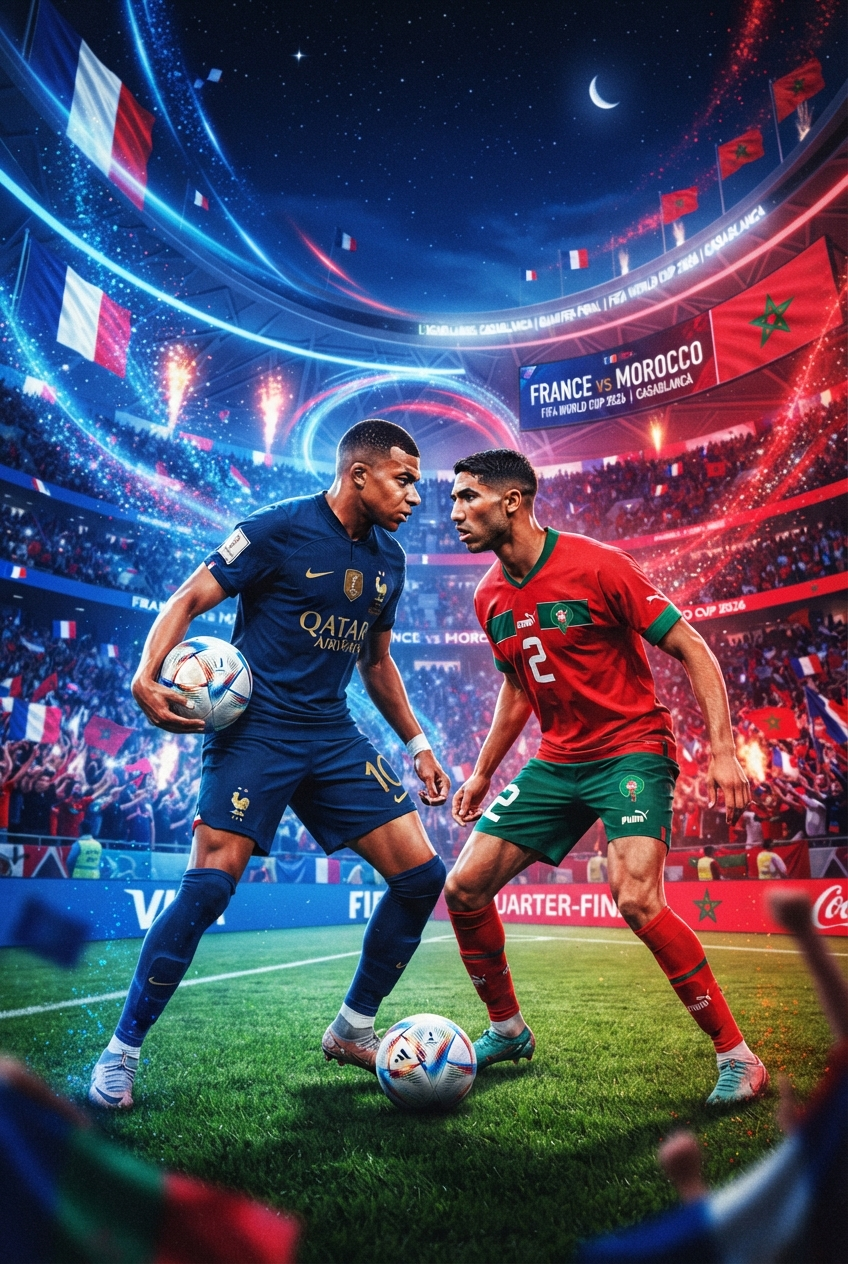
The France vs Morocco quarter-final on 9 July 2026 at Boston Stadium (Foxborough) is one of the most anticipated fixtures of this World Cup. Les Bleus — 2018 champions and 2022 runners-up — face the Lions of the Atlas, semi-finalists in 2022 and back among the global elite. WOP360 breaks down paths to the last eight, tactics, predicted lineups, our prediction and what's at stake — with links to the Match Center and our France squad guide and Morocco desk.
Beyond sport, this tie revives memories of the 2022 semi-final (France won 2-0). Morocco has since consolidated its status; France targets another semi-final berth. Kick-off is scheduled for evening Eastern Time — check the official FIFA match page for exact times in France, Morocco and North America.
This is the first 48-team World Cup, co-hosted by the United States, Canada and Mexico. The expanded format means more knockout rounds and fewer rest days between games — squad depth and medical staff become as important as tactical plans. France enter as Group I winners with nine points; Morocco finished second in Group C behind Brazil on goal difference, a result that underlines their competitiveness against elite opposition.
Context: a historic quarter-final
Played in the Boston area, this clash pits two nations that have shaped recent World Cups. France remain Europe's benchmark with rare squad depth; Morocco prove their 2022 run was no fluke through recognised tactical organisation and improving attacking talent.
The stakes are twofold: for France, confirming favourite status in a 48-team tournament; for Morocco, beating a major nation in knockout football. Expect electric atmospheres in the stands and fan zones from Paris and Casablanca to Montreal.
Boston Stadium (Gillette Stadium) holds around 65,000 seats and has hosted major international fixtures before. The New England region has a large Moroccan and French diaspora — ticket demand on secondary markets has been intense since the bracket was confirmed. For neutral observers, this quarter-final is a benchmark for whether African football can repeat its 2022 breakthrough at the highest level.
France's path to the quarter-finals
Les Bleus opened Group I with a statement win over Senegal (3-0, Mbappé brace), followed by 4-0 against Iraq before topping the group with a 2-1 win over Norway. Didier Deschamps can rotate without losing intensity — decisive on a compressed schedule.
- Strengths: ball control, quick transitions, effective pressing, attacking depth
- Core XI: Maignan solid; Saliba–Konaté at centre-back; Tchouaméni in midfield; Mbappé and Dembélé in attack
- Bench: Camavinga, Griezmann, Thuram, Coman to change tempo
France have conceded few clear chances; killing games before the hour limits late exposure. Full breakdown on our France World Cup 2026 guide.
Against Norway in the final group game, Deschamps rested several starters yet still controlled possession and created high-quality chances — a sign that the bench can step up without disrupting rhythm. Mbappé leads the tournament scoring charts with five goals; his partnership with Dembélé on the right has been France's most productive channel in open play. Defensively, Saliba and Konaté have allowed few headers inside the box, which matters against En-Nesyri.
Morocco's run: discipline and progress
The Lions opened Group C with a 1-1 draw against Brazil (match report, Saibari goal), beat Haiti, then won 2-1 at Scotland to reach the knockouts. Mohamed Ouahbi built a compact side that defends deep and strikes on the break.
- Defence: disciplined block, Bounou decisive, Aguerd and Riad solid
- Midfield: Ounahi as metronome, Bouaddi and El Khannouss improving
- Attack: Hakimi overlapping, Brahim Díaz creative, En-Nesyri in the box
Morocco excel on set pieces and managing big-game emotion — lessons from 2022. See our Morocco–Scotland preview for Group C context.
The draw with Brazil announced Morocco's intent: Saibari's equaliser came from a quick transition after Bounou had denied a dangerous chance. Against Haiti, the Lions controlled the second half without overexposing themselves. The Scotland win at Gillette — the same venue as this quarter-final — gave Ouahbi's squad familiarity with the pitch, travel logistics and local climate. That home-advantage-by-proxy could matter in a tight knockout tie.
Symbolic rematch after 2022
In the 2022 semi-final, France won 2-0 in a match Morocco pushed but lacked cutting edge. Four years on, the Lions return with more collective experience and players at top European clubs.
Moroccan supporters see this quarter-final as a chance to rewrite history. French staff must avoid complacency: Denmark's group-stage block in 2022 showed Les Bleus can be neutralised by a low, disciplined shape — similar to Ouahbi's default setup.
Two opposing tactical philosophies
France favour quick possession, wing acceleration (Hernandez, Koundé), offensive power and one-v-one quality. Deschamps sometimes allows the opponent the ball in a low block to explode in transition — effective against high lines.
Morocco rely on tactical discipline, defensive solidarity, rapid counters through Hakimi and Díaz, and efficiency in front of goal. Ouahbi can switch between 4-2-3-1 and 4-1-4-1, with selective pressing on French build-up players.
The key battle is midfield: Tchouaméni–Camavinga vs Ounahi–Bouaddi. If France control that zone, Morocco drop into a ten-man block; if the Lions win the ball high, Mbappé and Dembélé run into space.
Head-to-head and recent form
France and Morocco have met only once at a World Cup — the 2022 semi-final in Qatar. Friendly and Nations League encounters are rare; both federations treat this as a standalone knockout with no recent rehearsal. France's last competitive loss in a major tournament knockout came in the 2020 Euro final; Morocco's last World Cup knockout exit was that same 2022 semi.
Form entering the quarter-final favours Les Bleus on paper: three wins in Group I, twelve goals scored, two conceded. Morocco's record is one win, one draw, one win — seven points, six goals for, four against. The Lions' strength is not volume but efficiency: they rarely dominate possession yet rarely concede more than one big chance per half when organised.
Individual match-ups to track: Mbappé vs Aguerd on the left channel; Dembélé vs Mazraoui on the right; Ounahi vs Tchouaméni in the central corridor. If France win the wide battles, Morocco's full-backs cannot join attacks; if Hakimi and Mazraoui get forward, Hernandez and Koundé face 2v1 situations on transitions.
Predicted lineups
France (4-3-3): Maignan; Koundé, Saliba, Konaté, Hernandez; Tchouaméni, Camavinga, Griezmann; Dembélé, Mbappé, Thuram (or Giroud depending on Morocco's defensive profile).
Morocco (4-2-3-1): Bounou; Hakimi, Aguerd, Riad, Mazraoui; Bouaddi, Ounahi; Díaz, Saibari, El Khannouss; En-Nesyri. Hakimi and Mazraoui must manage Hernandez's runs and Mbappé's depth.
Official elevens are confirmed one hour before kick-off on FIFA and the WOP360 Match Center. Check late for suspensions and injuries.
Deschamps may prefer Thuram's mobility against a deep block, or Giroud's hold-up play to bring Griezmann into the game. On the Moroccan side, Saibari's energy in the number ten role could start ahead of El Khannouss if Ouahbi wants more pressing on French centre-backs. Mazraoui's fitness after a heavy group stage will be confirmed in training — his replacement would likely be Aboukhlal or Attiat-Allah with a more conservative role.
Key France players to watch
- Kylian Mbappé (captain) — pace, finishing, runs in behind; Morocco's top defensive priority
- Ousmane Dembélé — unpredictability, dribbling, drawing fouls on the right
- Eduardo Camavinga — recovery and progression if Morocco press high
- Aurélien Tchouaméni — midfield anchor, secures defensive transitions
- Mike Maignan — complete keeper, strong distribution under pressure
Griezmann remains the link between lines; his movement can unlock a compact Moroccan block. Coman, Barcola and Koné offer different profiles from the bench.
Key Morocco players to watch
- Achraf Hakimi — tournament's best attacking full-back; direct duels with Hernandez and Mbappé
- Brahim Díaz — creativity, line-breaking dribbles, set-piece threat
- Azzedine Ounahi — technical metronome, press resistance and vertical passes
- Youssef En-Nesyri — aerial threat, runs in behind on Hakimi crosses
- Yassine Bounou — experienced keeper, reliable and strong on penalties
Saibari and El Khannouss may rotate; their ability to defend in a mid-block will be tested by French pace. Ziyech or Harit can add attacking weight late if Morocco chase the game.
Tactical keys in the quarter-final
- Midfield control — who sets the tempo in the first 30 minutes?
- Finishing — Morocco must convert rare chances; France can kill the game in one sequence
- Transitions — Hakimi vs Hernandez pace; Dembélé vs Mazraoui one-v-one
- Set pieces — dangerous zone for Morocco on corners and wide free kicks
- Defensive discipline — avoid cards and cheap fouls on Mbappé in the box
Summer heat and humidity in Boston may favour rhythm management: extra rotation and tactical cooling breaks in the second half. Deschamps and Ouahbi know knockout football — substitutions between the 60th and 75th minute could decide it.
WOP360 prediction
On paper, France remain favourites (~60% indicative probability) thanks to squad depth and attacking power. Morocco can neutralise (low block + transitions) and force extra time or penalties — plausible if Bounou is outstanding.
Score prediction: France 2-1 Morocco — Mbappé or Thuram decisive, Moroccan reply from a set piece or counter (En-Nesyri or Díaz). Cautious variant: 1-1 after 90 minutes. Editorial forecast only; follow the Match Center for live scores on match night.
Alternative scenarios: a 0-0 or 1-1 after 90 minutes would suit Morocco's game plan and test France's patience — Les Bleus have depth for extra time but penalties introduce variance (Bounou's record is a factor). A 3-0 French win would require early goals that force Morocco to open up; unlikely before the hour unless Mbappé punishes a defensive error in the first fifteen minutes.
Where to watch: TV and Match Center
In France, FIFA rights holders broadcast the game (M6 / beIN Sports by region). In Morocco, SNRT and beIN cover the tournament. In the US and Canada, FOX/Telemundo/TSN by market.
Live score, official lineups and updated standings: World Cup 2026 Match Center · filter by France or Morocco · France desk · Morocco desk.
Stats and trends before the quarter-final
Over France's last ten major knockout games since 2018, they average more than two goals scored. Morocco concede less than one per match when defending in a low block — consistent with 2022 and their 2026 campaign.
Hakimi–Hernandez and Mbappé–Aguerd duels will dominate data rooms: top speed, sprint distance and transition xG. France generate more volume; Morocco optimise shot quality (few chances, goals from set pieces or counters).
Historically, quarter-finals pairing an African nation with a European favourite produce tight scores: three of the last five such ties finished by one goal or went to extra time — context for an open game until the final whistle.
Semi-final implications
The winner likely faces a South American or Iberian opponent on FIFA's bracket — with a path toward MetLife Stadium or Los Angeles. For France, a semi confirms 2022-level performance; for Morocco, it would match or exceed 2022's historic run across North African football.
Both squads manage demanding schedules: rotation, recovery and minor knocks (hamstrings, ankles) will be monitored in pre-match press conferences. Deschamps rotates carefully; Ouahbi relies on group solidarity over individual bench depth.
Expert analysis (E-E-A-T)
"A France–Morocco quarter is never routine: Morocco learned from 2022 and France know a well-organised low block can frustrate them. It will be decided in midfield and finishing — statistically France hold the edge, but Bounou and Hakimi can swing it in one moment. I'd expect a narrow French win with Morocco dangerous until the final whistle." — Camille Rousseau, WOP360 Sport desk
Frequently asked questions (FAQ)
When is France vs Morocco in 2026?
Quarter-final on Thursday 9 July 2026 at Boston Stadium (Foxborough). Check FIFA for exact kick-off times in your timezone the day before.
What is the France vs Morocco prediction?
WOP360 predicts a 2-1 France win, with Morocco capable of pushing to extra time through their defensive block and transitions.
Have France and Morocco met at a World Cup before?
Yes — 2022 semi-final, France won 2-0. Morocco seek symbolic revenge in 2026.
What are the predicted lineups?
France 4-3-3 (Maignan, Mbappé, Tchouaméni, Dembélé…); Morocco 4-2-3-1 (Bounou, Hakimi, Ounahi, Díaz, En-Nesyri). Official teams one hour before kick-off.
Where to watch in France?
M6 and beIN Sports 1 in metropolitan France; SNRT/beIN in Morocco. Live score on WOP360 Match Center.
Which players should I watch?
France: Mbappé, Dembélé, Tchouaméni, Maignan. Morocco: Hakimi, Ounahi, Brahim Díaz, En-Nesyri, Bounou.
What does the winner get?
A World Cup semi-final: France confirm favourite status; Morocco match or exceed their 2022 historic run.
Where is the France vs Morocco quarter-final played?
Boston Stadium (Gillette Stadium) in Foxborough, Massachusetts — the same venue where Morocco beat Scotland in the group stage.
Who are the coaches?
Didier Deschamps for France (2018 World Cup winner as manager); Mohamed Ouahbi for Morocco, who succeeded Walid Regragui after the 2022 cycle.
Conclusion and next steps
The France vs Morocco quarter-final captures everything great about a World Cup: history, contrasting styles, stars on both sides and a semi-final place at stake. France remain favourites; Morocco have the tools to upset.
Follow the match on the WOP360 Match Center, read our France guide and Morocco–Brazil report, and browse Sport · France · Morocco.
WOP360 will update this file when official lineups drop and after kick-off on 9 July 2026. Enable Sport alerts for live reports and post-match reaction.